


.jpg)
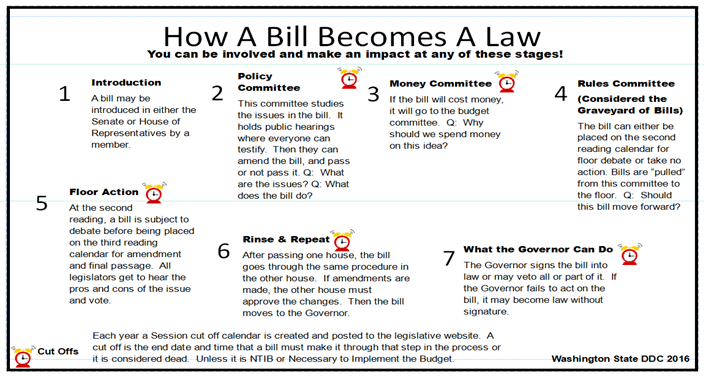
Right now in the legislative Session, bills are in the later stages of the process. Both the visual graphic and the typed list below show the full steps of how a bill becomes a law, from introduction through action by the Governor. In the visual graphic, the steps are numbered from one through seven and arranged in order to show how a bill moves through committees, floor votes, and then to the Governor. Several of the later steps are marked with red circles to show where most bills currently are in the process.
At this point in the Session, bills are mainly in Step 4 (Rules Committee), Step 5 (Floor Action), and Step 6 (Rinse and Repeat). In the visual, these steps are highlighted to show that they come after policy and budget review and before the bill goes to the Governor. The visual also includes an arrow that shows a bill moving from one legislative house to the other after it passes a floor vote. For readers using screen readers, the typed version below lists each step in order and explains what happens at each stage.
This step is where many bills wait to be selected for a floor vote. The Rules Committee does not hold regular public meetings. Legislators have a limited number of chances, called “pulls,” to move bills from this committee to the floor. Reaching out to Rules Committee members about bills you care about can help encourage action. If a bill does not move out of the Rules Committee, it is usually considered dead, unless it is NTIB, or Necessary to Implement the Budget.
This step is when the full House or Senate debates and votes on the bill. You can check the legislative floor calendar online to see which bills are scheduled for votes. This schedule can change, so it is important to check often. Members of the public can also watch the voting in person from the House or Senate gallery.
After a bill passes in one house, it goes through the same process in the other house. In the visual graphic, this is shown with an arrow pointing from one side of the process back to the committee steps again. Tuesday, February 17, 2026 is the house of origin cut off. This is the deadline for a bill to pass the floor in its original house so it can move forward to committees in the other house. If your bill is still active at this point, now is the time to prepare testimony for the policy committee in the opposite chamber.
A Note on Budgets
As of this writing, the House and Senate budgets have not yet been released. The disability community has significant concerns about this year’s budgets. Please watch for updates if you are interested in providing testimony or submitting written comments once the budgets are introduced.
You can be involved and make an impact at any of these stages!
A bill may be introduced in either the Senate or House of Representatives by a member.
This committee studies the issues in the bill. It holds public hearings where everyone can testify. Then they can amend the bill, and pass or not pass it. Q: What are the issues? Q: What does the bill do?
If the bill will cost money, it will go to the budget committee. Q: Why should we spend money on this idea?
The bill can either be placed on the second reading calendar for floor debate or take no action. Bills are “pulled” from this committee to the floor. Q: Should this bill move forward?
At the second reading, a bill is subject to debate before being placed on the third reading calendar for amendment and final passage. All legislators get to hear the pros and cons of the issue and vote.
After passing one house, the bill goes through the same procedure in the other house. If amendments are made, the other house must approve the changes. Then the bill moves to the Governor.
The Governor signs the bill into law or may veto all or part of it. If the Governor fails to act on the bill, it may become law without signature.
Each year a Session cut off calendar is created and posted to the legislative website. A cut off is the end date and time that a bill must make it through that step in the process or it is considered dead. Unless it is NTIB or Necessary to Implement the Budget.
Mailing Address:
PO Box 48314
Olympia, WA 98504-8314
