DDC History and Visioning

1970's

1970's Report on Institutions
A 1970-era Washington State planning report identifies deficiencies in institutional care and outlines a coordinated strategy to improve facilities, update laws, and expand community-based services for people with developmental disabilities.
1974 Memo on Institutions
A 1974 Washington State memo outlines the planning, data collection, and community coordination needed to shift services from large institutions to community-based programs for people with developmental disabilities, mental health needs, and justice-involved youth.
1976 Original Executive Order Establishing Council
Washington’s governor formally established the state’s Developmental Disabilities Planning Council in 1976, defining its membership, responsibilities, and federal compliance requirements under Public Law 94-103.
1973 Report on Deinstitutionalization
A 1973 Maryland report lays out a financial and programmatic plan for replacing large institutions with a statewide network of community-based services and supports for people with intellectual and developmental disabilities.
1979 Deinstitutionalization Lawsuit
A 1979 AFSCME complaint and accompanying federal guidelines reveal significant concerns about Rhode Island’s failure to provide required job protections for employees affected by deinstitutionalization, prompting calls for stronger state and federal enforcement.
1978 Public Law 94-142
A 1978 review of P.L. 94-142 outlines the administrative responsibilities states assumed to implement special education services and protect children’s rights under the new federal law.
1979 Education for All Executive Summary on Progress
The inaugural Congressional report on P.L. 94-142 shows major early gains in providing special education services nationwide, alongside the challenges states faced as they built the systems needed to meet the law’s promise.
Video Interview - Robert Wardell
Robert Wardell recounts his experience living in two of Washington State's residential habilitation centers (also known as RHC's or institutions) and his journey to living in the community. He also shares some tips for advocacy and his hope for future IDD advocates.
1976 Education for All
Together, these 1976 documents outline federal expectations, implementation steps, advocacy roles, and legislative context for the Education for All Handicapped Children Act as states prepared to ensure every child with a disability received a free, appropriate public education.
1976 Editorial on Special Education
This 1976 article describes how special education programs in Washington pioneered accountability systems—using clear goals, measurable objectives, and progress tracking—that later influenced broader public school practices.
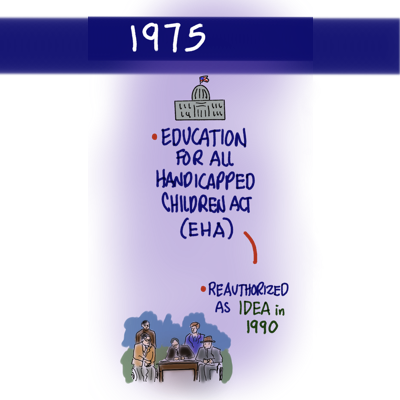
1975 Education for All Public Law
This document provides congressional history, committee explanations, and statutory language related to federal legislation on the education of children with disabilities, detailing the intent, requirements, and protections included in the law.
1971 Proposed Legislation Education for All
This document explains Washington’s early efforts in 1970–71 to expand educational services for children with disabilities, including new requirements for school districts, guidance for identifying and serving students, and advocacy efforts under “Education for All.”
1971 OSPI Steering Committee
These minutes outline a 1971 Steering Committee meeting focused on organizing Washington’s implementation of mandatory education for children with disabilities and establishing the ad hoc committees needed to guide policy, eligibility, program standards, and oversight.
1970's No Paid Services Caseload
State officials in 1970 discuss the large number of unserved children with disabilities in Washington and propose a meeting to identify the scope of the issue, current gaps, and possible solutions.
View the full archive