DDC History and Visioning

Archive

Archive Materials

Back to History and Visioning Main Page

On this site, you’ll find archival materials, timelines, recorded interviews, visual storytelling, and documents developed throughout the History and Visioning Project. These resources reflect the Council’s evolution and highlight the voices of people with developmental disabilities, family members, advocates, and allies who have been part of the movement.

The History and Visioning Project honors the Washington State Developmental Disabilities Council’s 50-year journey of advancing disability rights and inclusion across Washington. Established in 1976, the Council has worked alongside self-advocates, families, and community partners to create lasting systems change. This project looks back at that history while charting the Council’s future—documenting milestones, collecting personal stories, and identifying themes that will guide priorities for the years ahead. Through outreach to past and present Council members and the broader disability community, the project preserves a shared history and strengthens the foundation for a more equitable and inclusive Washington.

This is a living project that will continue to grow over time, so we invite you to return and see new stories, reflections, and milestones as they are added.

Select Categories to Filter Archive Materials

Filter by decade:
Filter by Category:
Thank you! Your submission has been received!
Oops! Something went wrong while submitting the form.
1957 Letter on ARC's Non-Profit Status
A 1957 IRS ruling confirms The ARC of Washington’s federal tax-exempt status and outlines the benefits, limitations, and reporting requirements tied to its 501(c)(3) designation.
1960s: Exposing the Abuse of Civil Rights
In the 1960s, national exposure of civil rights abuses in institutions—including Willowbrook, Pennhurst, and the documentation in Christmas in Purgatory—helped launch the modern disability rights movement.
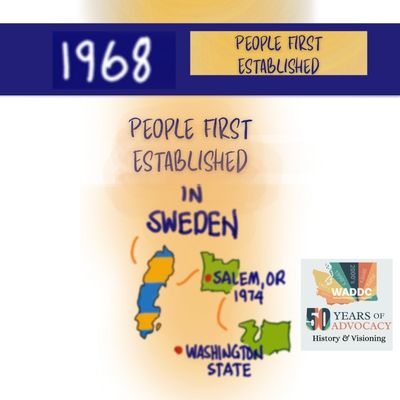
1960’s The Roots of the People First Movement
The People First movement began in the late 1960s when people with intellectual and developmental disabilities organized to speak for themselves, shaping a powerful self-advocacy movement that emphasized choice, leadership, and the belief that people are more important than labels.
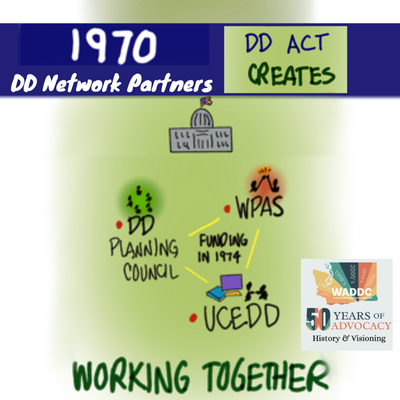
1970 - The DD Act
Through the DD Act, the federal government established DD Councils and a national network dedicated to strengthening disability rights, promoting community living, and ensuring that people with developmental disabilities guide decisions that affect their lives.
1970's No Paid Services Caseload
State officials in 1970 discuss the large number of unserved children with disabilities in Washington and propose a meeting to identify the scope of the issue, current gaps, and possible solutions.
1970's Report on Institutions
A 1970-era Washington State planning report identifies deficiencies in institutional care and outlines a coordinated strategy to improve facilities, update laws, and expand community-based services for people with developmental disabilities.
1970-2000 National DD Council History
A timeline from ITACC traces how the DD Act evolved from 1970 to 2000 into a comprehensive civil rights and community-living framework centered on inclusion, self-determination, and strong advocacy roles for DD Councils.
1971 OSPI Steering Committee
These minutes outline a 1971 Steering Committee meeting focused on organizing Washington’s implementation of mandatory education for children with disabilities and establishing the ad hoc committees needed to guide policy, eligibility, program standards, and oversight.
1971 Proposed Legislation Education for All
This document explains Washington’s early efforts in 1970–71 to expand educational services for children with disabilities, including new requirements for school districts, guidance for identifying and serving students, and advocacy efforts under “Education for All.”
1973 Report on Deinstitutionalization
A 1973 Maryland report lays out a financial and programmatic plan for replacing large institutions with a statewide network of community-based services and supports for people with intellectual and developmental disabilities.
1974 Memo on Institutions
A 1974 Washington State memo outlines the planning, data collection, and community coordination needed to shift services from large institutions to community-based programs for people with developmental disabilities, mental health needs, and justice-involved youth.
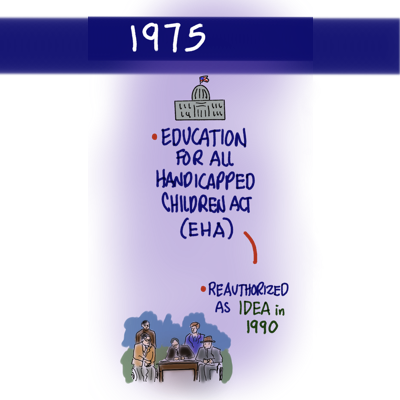
1975 Education for All Public Law
This document provides congressional history, committee explanations, and statutory language related to federal legislation on the education of children with disabilities, detailing the intent, requirements, and protections included in the law.
1976 Editorial on Special Education
This 1976 article describes how special education programs in Washington pioneered accountability systems—using clear goals, measurable objectives, and progress tracking—that later influenced broader public school practices.
1976 Education for All
Together, these 1976 documents outline federal expectations, implementation steps, advocacy roles, and legislative context for the Education for All Handicapped Children Act as states prepared to ensure every child with a disability received a free, appropriate public education.
1976 Original Executive Order Establishing Council
Washington’s governor formally established the state’s Developmental Disabilities Planning Council in 1976, defining its membership, responsibilities, and federal compliance requirements under Public Law 94-103.
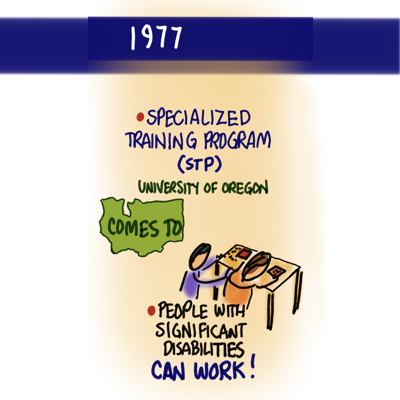
1977: Specialized Training Program at the University of Oregon
The Specialized Training Program at the University of Oregon helped expand access to meaningful work and shaped a generation of leaders who built lasting disability services in Washington State.
1978 Public Law 94-142
A 1978 review of P.L. 94-142 outlines the administrative responsibilities states assumed to implement special education services and protect children’s rights under the new federal law.
1979 Deinstitutionalization Lawsuit
A 1979 AFSCME complaint and accompanying federal guidelines reveal significant concerns about Rhode Island’s failure to provide required job protections for employees affected by deinstitutionalization, prompting calls for stronger state and federal enforcement.
1979 Education for All Executive Summary on Progress
The inaugural Congressional report on P.L. 94-142 shows major early gains in providing special education services nationwide, alongside the challenges states faced as they built the systems needed to meet the law’s promise.
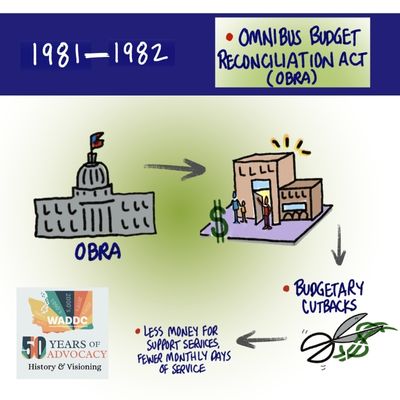
1981 Omnibus Budget Reconciliation Act (OBRA)
The 1981 Omnibus Budget Reconciliation Act changed Social Security disability rules in ways that made benefits harder to qualify for and reduced protections for people with disabilities — including those with intellectual and developmental disabilities.
1983-88 DD Legislation
A summary of Washington State legislation from 1983–1988 shows major advances in family support, employment, civil rights, and community services for people with developmental disabilities.
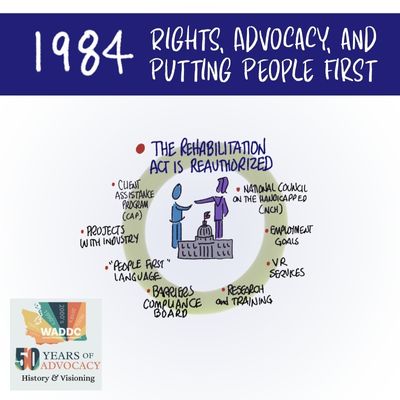
1984: Rights, Advocacy, and Putting People First
In the early 1980s, changes to federal disability policy strengthened self-advocacy, accountability, and people-first values, helping shift services toward individual rights, independence, and full participation in community life.
1985 AFSCME Report on Deinstitutionalization
A 1985 AFSCME publication reprints investigative reporting on the dangers and systemic failures that accompanied rapid, under-resourced deinstitutionalization in Ohio, highlighting its impact on people with developmental disabilities.
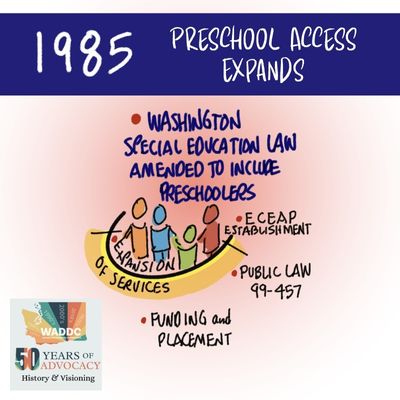
1985: Expanding Preschool Access for Children with Disabilities
By the mid-1980s, Washington State led the way in early childhood inclusion by expanding special education to preschoolers and strengthening early learning supports, helping establish early intervention as a foundation for inclusion and lifelong learning.
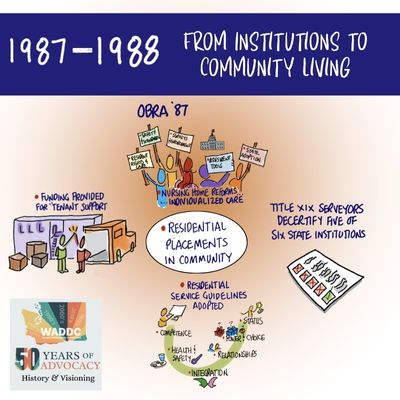
1987-1988: From Institutions to Community Living
In 1987–1988, Washington State accelerated its shift from institutions to community living after federal decertification exposed serious failures in institutional care, leading to expanded community supports and new Residential Services Guidelines shaped with input from the Developmental Disabilities Council and people with lived experience.
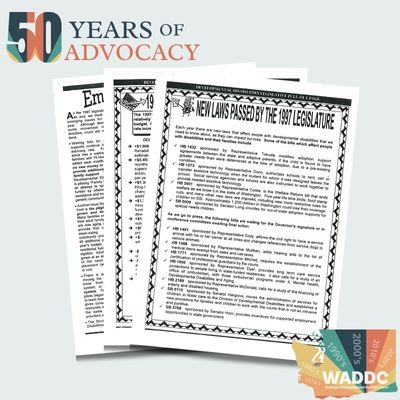
1997 Legislative Bills Passed
Washington’s 1997 legislature expanded supports and funding for people with developmental disabilities and their families.
1999 DDC Packet - May
This agenda outlines the May 21, 1999 meeting of the Developmental Disabilities Council’s Planning & Public Policy Committee, covering legislative updates, budget review, policy decisions, and preparation for upcoming Council work.
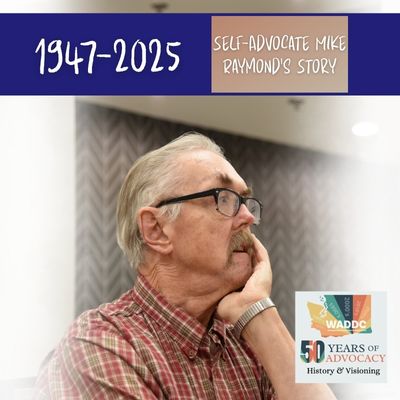
Self-Advocate Mike Raymond's Story
Mike Raymond’s journey from life inside Rainier School to becoming one of Washington’s most influential self-advocates helped shape the state’s disability rights movement and continues to guide efforts toward community-based supports today.
Video Interview - Robert Wardell
Robert Wardell recounts his experience living in two of Washington State's residential habilitation centers (also known as RHC's or institutions) and his journey to living in the community. He also shares some tips for advocacy and his hope for future IDD advocates.
Video Interview - Shawn Latham
Shawn Latham shares his perspective on disability advocacy and systems change. He talks about his own lived experience, his involvement with disability organizations, and what it has meant to be part of advocacy work over time.
Video Interview Diana Stadden
Diana reflects on decades of work in Washington’s disability community, sharing how listening to self-advocates and learning from people who experienced institutions helped drive progress toward true community inclusion.